
The Covenant in the Examination Hall
Every year, millions of families place years of sacrifice into the hands of institutions they have never met. That is an extraordinary act of public trust. This piece asks what we owe them in return — and what it costs a society when that trust begins to run dry.

On trust, stewardship, and the quiet hope that holds a generation together
He has been pacing since six in the morning.
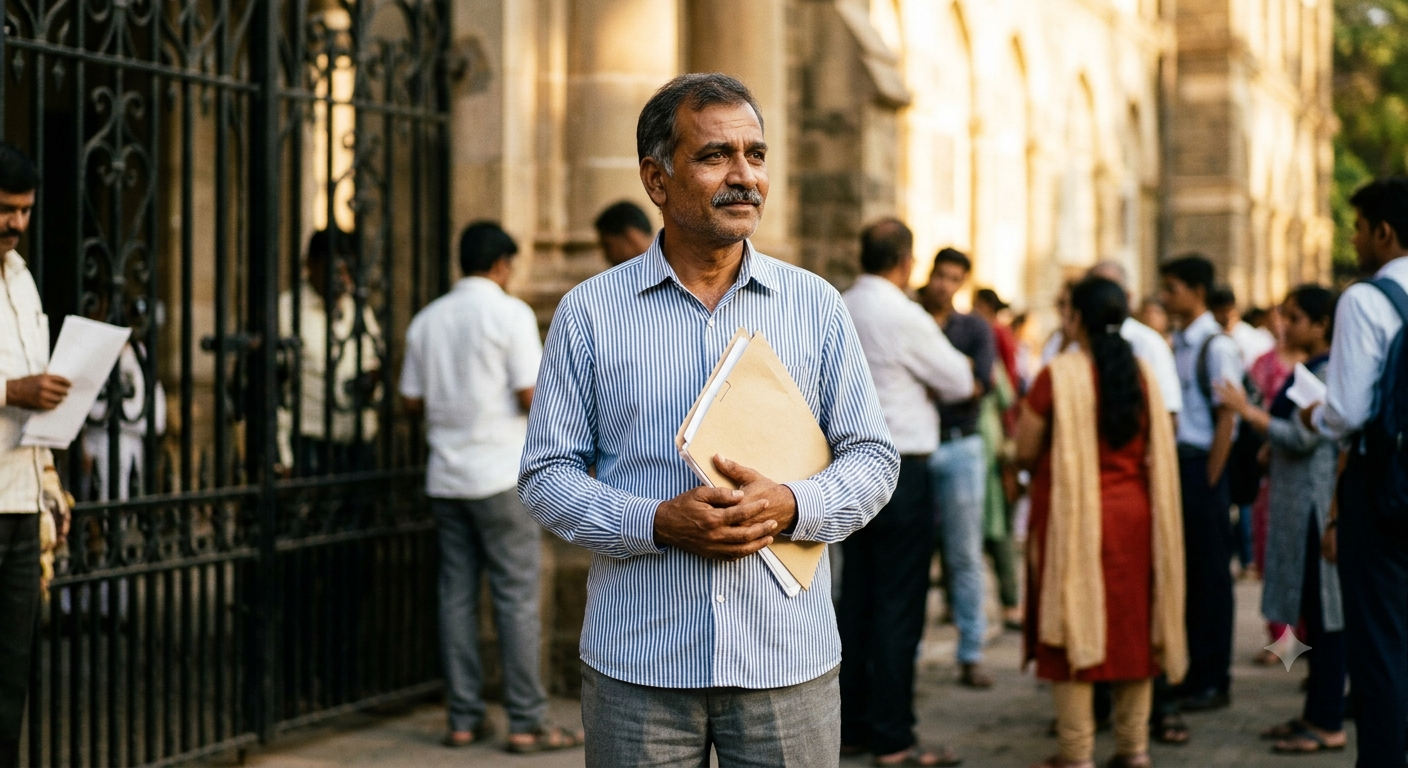
The examination hall does not admit parents, so the father circles the perimeter fence instead — a slow, restless orbit he has been making for the past hour. In his hand is a plastic folder. Inside: a copy of his daughter's admit card, a spare pen, and a coaching institute receipt he can almost recite from memory. That paper, worn soft from months of quiet handling, represents something a balance sheet cannot. School fees paid before household repairs. A holiday proposed and gently forgotten. A second shift taken without explanation, because explanation would have made the sacrifice feel like pressure.
His daughter is in row seven. She doesn't know he is standing outside.
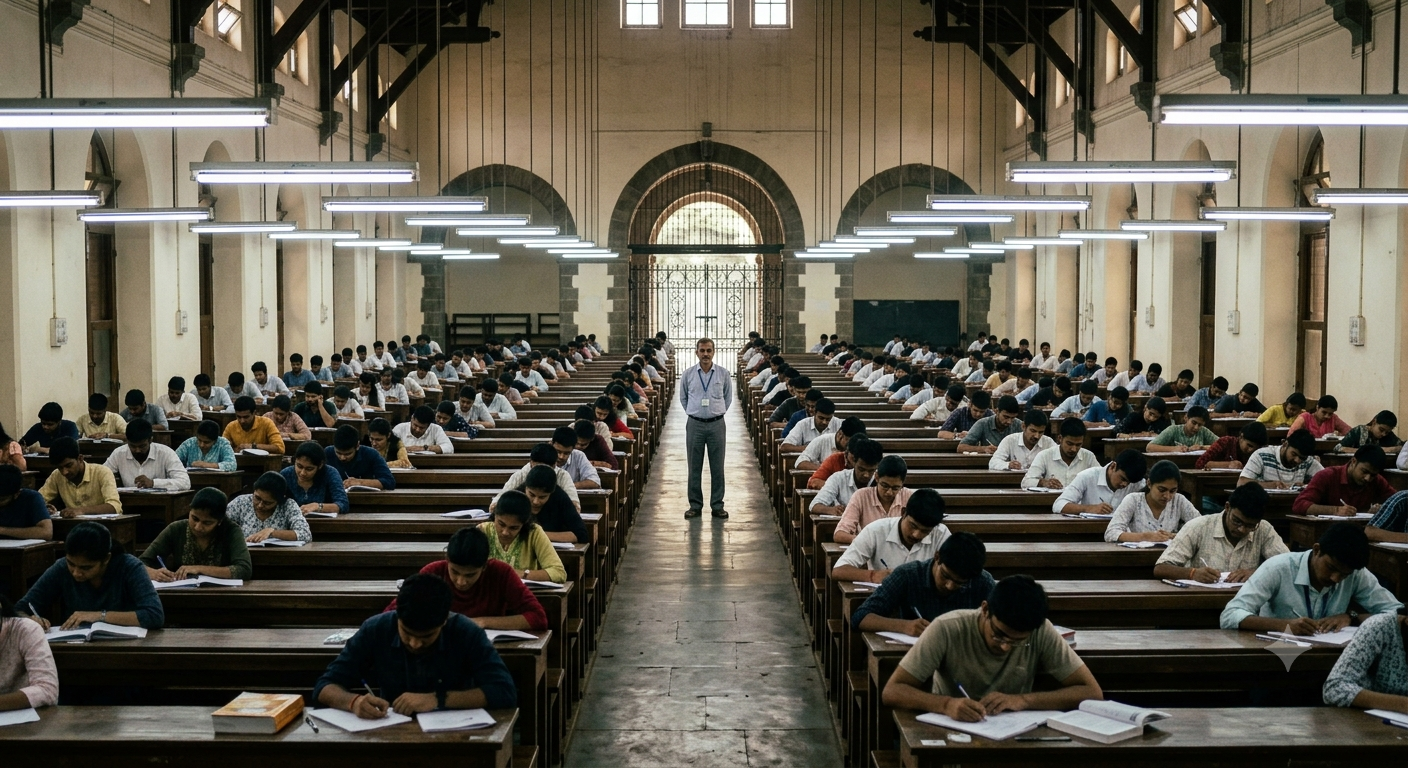
She sits before a pristine question booklet, reading carefully, the way she has learned to — slowly, twice, before writing anything. She is thinking about the one formula she revised last night at midnight, hoping it appears, hoping even harder that she hasn't confused it with the one that looks almost identical. Or perhaps she is thinking something entirely different. She is not thinking about the receipt. She probably suspects it exists. Children almost always do.
For a few hours, the world will narrow to thirty pages and a ballpoint pen. This is how it is supposed to work. A student prepares. An institution provides a fair arena. Effort is measured honestly. And somewhere in that quiet transaction, the invisible covenant that holds communities together is reaffirmed one more time.
But what happens when that covenant begins to fracture?
The Unwritten Promise
Across India, every examination season carries with it a weight that is difficult to articulate to anyone who hasn't lived it. It isn't simply academic pressure — that would be manageable, even productive. It is something deeper: the feeling that an entire family's trajectory hangs on a few hours that nobody in that family will be allowed to witness.
Parents measure time not by festivals or anniversaries but by syllabus deadlines. Siblings learn to move quietly through the house during revision hours. Grandparents begin to pray in advance of dates they've marked carefully on paper calendars.
This is not dysfunction. It is, in its own way, a form of love — love expressed through sacrifice, through patience, through an absolute and somewhat remarkable act of faith. The faith is this:
If we play by the rules, the system will be fair.
That belief is the real currency of any education system. Not infrastructure. Not syllabi. Not even the quality of teachers, though that matters enormously. What holds the entire architecture together is trust — the quiet, daily assumption that the process is honest, that merit will be seen, that the rules apply equally to everyone in that hall.
Trust is not an asset an institution owns. It is a resource that communities grant on loan, renewed only through consistent integrity.
The moment an institution begins to draw on that loan without repaying it — through opacity, through failure, through negligence — it is spending something that does not belong to it.
And eventually, that account runs dry.
Stewardship: A Different Way of Thinking About Responsibility
There is a word that surfaces rarely in policy discussions but deserves far more attention than it receives: stewardship.
A steward is not an owner. An owner can do what they like with what they possess. A steward holds something precious on behalf of others — and that distinction changes everything.
Governments don't own education. Examination boards don't own opportunity. No administrative body owns the futures of the young people who sit in those halls. They hold these things in trust — on behalf of students, on behalf of families, on behalf of a society that has agreed, collectively, that fair access to knowledge and merit-based recognition ought to be possible.
That is not a bureaucratic obligation. It is a moral one.
When we understand institutions through the lens of stewardship, the questions we ask change entirely.
Instead of "how do we protect the reputation of this body?" the question becomes "who was harmed, and how do we make them whole?"
Instead of "how do we manage this news cycle?" the question becomes "what structural flaw allowed this failure to occur, and what will future students experience differently because we took it seriously?"
These are harder questions. They require more courage to ask than a press release requires to write. But they are the questions that actually rebuild trust — because trust is not rebuilt through words. It is rebuilt through demonstrated change.
When Young People Take to the Streets
Public protest makes many people uncomfortable. That discomfort is sometimes appropriate.
History has seen anger become destructive. Violence, intimidation, the destruction of shared public spaces — none of these strengthen a legitimate grievance. If anything, they hand critics a reason to discuss the protest rather than the problem that caused it. Stewardship applies to civic life as much as to governance: how we disagree matters as much as what we are disagreeing about.
And yet.
History has also shown us, that many of the freedoms societies take for granted today exist because ordinary people — often young people — refused to accept that broken systems were simply the natural order. Peaceful dissent has repeatedly been one of society's more effective mechanisms for reminding institutions who they exist to serve.
Students do not generally wake up one morning and decide to abandon classrooms for street corners. For most, it is not a preference — it is what remains when every quieter avenue has been tried and ignored. Petitions unacknowledged. Queries unanswered. Formal complaints absorbed into silence. Not always refused — refusal, at least, is a response. Each attempt leaving them a little more certain that the system was not broken by accident — it was simply indifferent. Each attempt just quietly set aside, the way institutions sometimes set aside what they'd rather not see.
This does not mean every demand is wise. Nor does it mean every action taken in protest is justified. But stewardship asks us to look beyond the slogans and ask a more compassionate question: what experiences have led so many young people to believe that raising their voices publicly is the only option left?
Listening — genuinely listening, not listening in order to formulate a response — is one of the earliest and most important acts of stewardship. It signals that the institution remembers who it serves.
The same principle applies to those responsible for maintaining public order. Authority is strongest when it reflects confidence rather than defensiveness, patience rather than haste, and dialogue before confrontation. A society asks both its citizens and its institutions to exercise restraint — not because restraint is weakness, but because it is the only foundation on which trust can be rebuilt.
The Weight No Test Should Have to Carry
Here is the question that doesn't get asked often enough: why does a single examination carry such absolute, life-altering weight?
Not because examinations are inherently important — they can be genuinely useful measures. But because the path to security and dignity in a rapidly growing society has, over decades, narrowed to a critical few gateways. When an enormous population competes through a handful of high-stakes tests for a limited number of valued outcomes, the system doesn't simply experience pressure. It becomes pressure — dense, compacted, and, under the right conditions, explosive.
This scarcity has produced its own ecosystem. Coaching centres have grown into an industry unto themselves. Families who cannot afford them feel disadvantaged. Families who can, still feel the strain. The examination becomes not a measure of preparation but the preparation itself — a consuming, years-long identity that can crowd out curiosity, creativity, and the simple pleasure of learning something because it is interesting.
When a single test is asked to determine a young person's entire trajectory, the stakes become absolute. And absolute stakes breed desperation. Desperation creates temptation. And temptation, as any system designer will tell you, finds and widens every crack.
Strengthening examination security is necessary. Prosecuting wrongdoing is necessary. But stewardship asks us to think beyond repairing individual failures. It asks whether we have built a system in which too much hope rests upon too few pathways — and whether that imbalance is itself a form of institutional failure, one that predates any single scandal.
Could more pathways be made genuinely valuable, not merely available? Could vocational education carry real dignity rather than being perceived as a consolation prize? Could the metrics of a successful life be broadened, in both policy and culture, so that one examination is not asked to carry more weight than any examination reasonably should?
These are not easy questions. They don't resolve in a news cycle. But they are the questions that matter most — because they address the root, not merely the symptom.
Accountability That Actually Heals
When institutions fail, public conversation moves quickly to punishment. This is understandable. It is also insufficient.
Removing an individual may settle a legal account, but it does not heal an institution. If the same structural vulnerabilities remain — the same gaps in oversight, the same culture of defensiveness, the same absence of whistleblower protections or independent review — then the failure is not really addressed. It is merely personified and removed.
Restorative accountability asks different questions. Not only who is responsible? but what allowed this to happen? Not only what is the penalty? but what changes will the next generation of students actually experience? Not only have we punished the wrongdoer? but have we made whole the people who were harmed?
These are not softer questions. In many ways, they are harder — because they require institutions to examine themselves, not just individuals within them. They require the courage to admit that a failure was systemic, not aberrational. And they require the patience to rebuild confidence through demonstrated action, not announcements.
Justice and restoration are not opposing ideas. A healthy society needs both. Institutions show their true character not in how they behave when everything is working, but in how they respond when something breaks.
The Generation Being Formed Right Now
There is a dimension to this moment that tends to be overlooked in the noise of debate.
The young woman holding a handwritten placard may one day become a judge. The young man standing at the edge of a crowd, listening, not quite sure what to think, may one day run a hospital or a school. The student who files a complaint through the correct channels and waits quietly for a response is practicing something — she is learning, viscerally, whether institutions reward or punish that kind of civic patience.
How we treat young people in moments of institutional failure teaches them something permanent. It teaches them what power looks like when it is tested. It teaches them whether transparency is a real value or a ceremonial one. It teaches them whether the rules they are asked to follow apply equally to everyone, or whether that promise is conditional.
The habits and values of a generation are shaped not only in classrooms, but in how the institutions of their youth respond when those institutions are challenged.
If they learn that institutions only listen when trust has completely collapsed, they may one day govern the same way. If they experience something different — humility, honest accountability, stewardship, a genuine effort to make things right — they carry that experience with them. And they may build institutions that are stronger than the ones they inherited. They may build something better. Not because they read about justice in a classroom, but because they felt its absence, and decided that was not the world they wanted to pass on.
Preparing future leaders begins long before they occupy positions of authority. It begins by showing them what responsible authority actually looks like.

The Desk Lamp Burning Late
Somewhere tonight, long after this article has been read and the news cycle has moved on to something else, a student is sitting at a desk.
The textbooks are open. The notebook is half-filled with handwritten notes. The phone has been turned face-down, not switched off — that would be too definitive — just quietened for now. Outside the window, the street sounds are fading. A dog barks twice. A scooter passes. Silence returns.
The student turns a page and continues to read.
Not because the system has been proven worthy. Not because every doubt has been resolved. But because, despite everything — despite the fractures and the headlines and the quiet, gnawing anxiety about what any of this means for their future — something still holds.
The belief that learning matters. That honesty counts. That effort ought to mean something.
That belief is not naive. It is not the absence of awareness. It is, in fact, one of the more courageous things a young person can choose to sustain in an uncertain world.
When a student walks into an examination hall and places years of effort into the hands of an institution they have never met, they are performing an act of remarkable public trust. They are saying: I believe this system can be fair. I believe my work will be seen. I believe the rules apply to everyone here.
The least we can do — the very least — is make sure that belief is not misplaced.
This piece was published by Triquetrus Institute as part of an ongoing reflection on education, institutional responsibility, and the values that shape a society's future. Triquetrus Institute engages with contemporary public issues through the enduring principles of stewardship, human dignity, institutional responsibility, and long-term societal flourishing. The Institute does not represent or advocate for any political party, government, or movement.
Institutional Disclaimer
The Triquetrus Institute is an internal research and reflection initiative of Triquetrus Initiatives LLP (India). All content published by the Institute is intended solely for educational and discussion purposes. It does not constitute legal, financial, investment, regulatory, or professional advice and should not be relied upon as such.
Attribution and Usage Rights
Images accompanying this article have been generated using artificial intelligence models and are presented for illustrative purposes only. Such images are synthetic in nature and should not be interpreted as factual representations of real persons, events, or conditions.
This article is subject to the full Content Ownership, Usage Rights, Liability Disclaimer and all applicable Terms and Conditions available at the Triquetrus Collective Legal Portal:
https://ti.triquetruscollective.com/triquetrus-collective-legal-portal/
Readers agree to these terms by engaging with the content.
Copyright © 2026 Triquetrus Initiatives LLP, India. All rights reserved.